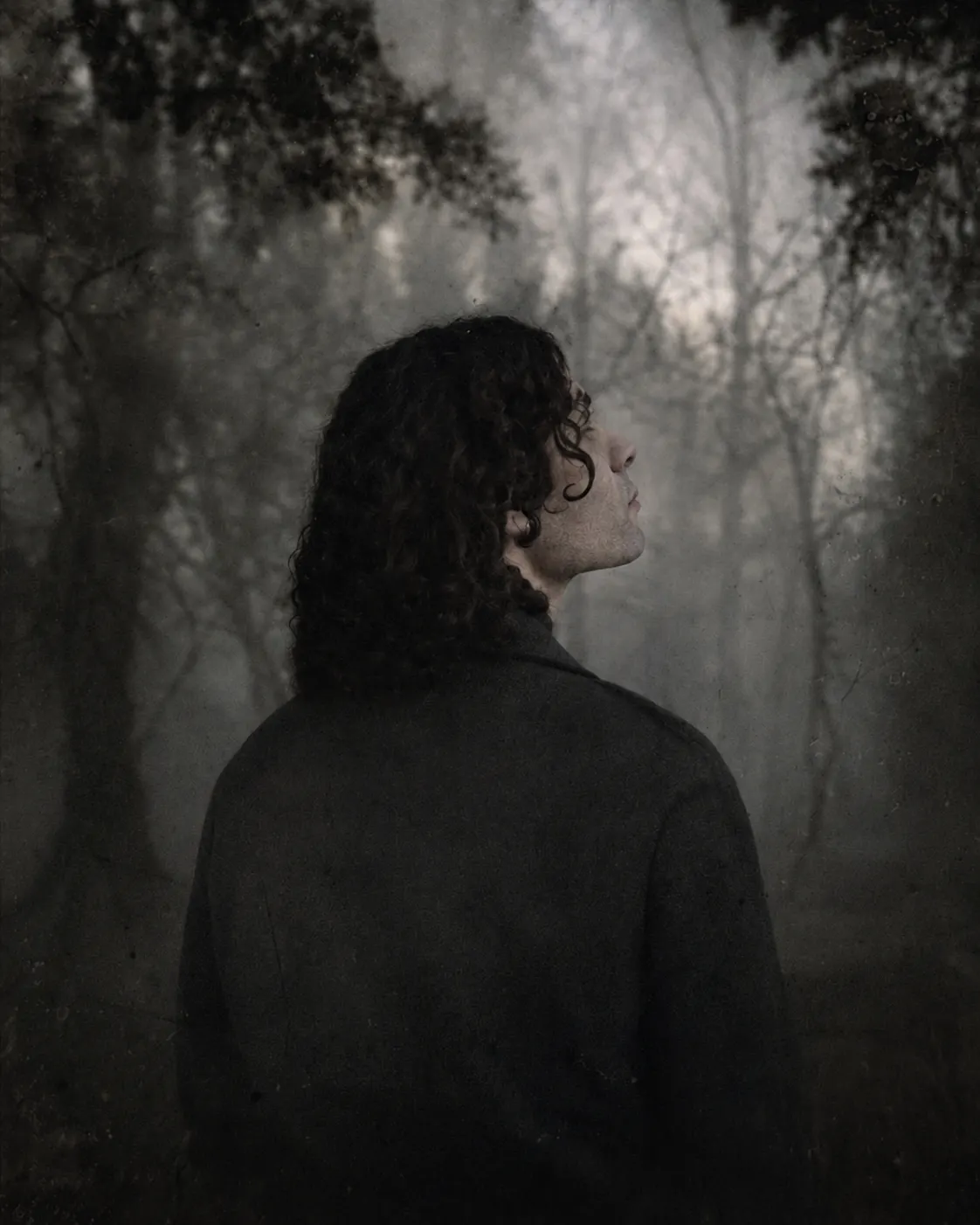
It took me more than a quarter of a century to come close to painting. I certainly drew as a child, but it would be a lie to say that from a young age I felt called to paint. I encountered music in adolescence, and that was my first artistic love. A first love destined to fade because of bad teachers and my limited inclination to perform for an audience. Fortunately, beyond performance I explored from the very beginning the solitary and isolated practice of composition, and it is this that prevented me from walking away from music entirely. When my studies were over, a passion for images began to make its way within me, prevailing over my interest in sound. In the same period, some mysterious childhood dreams returned vigorously to my memory. Colossal castles, stormy seas, ancient ruins and stone devoured by time. And so, cliché as it may seem, I cannot deny that the images I paint come from my dreams — old and recent — and from my unconscious fantasies. When I close my eyes and let myself sink inward, rivers of visions flow to me. I am not always strong enough to seize one and bring it to the surface, but when I manage to, the artisanal process of my art begins: the search for a compromise between the impalpable perfection of the dream-world and the solid, material nature of a painting — often executed on heavy wooden panels. The greatest challenge is keeping the received inspiration pure while attempting to give it concrete form. It is not rare for this process to fail, but when it succeeds I consider myself satisfied with my work. Parting with a painting born of such intimate inspiration is never easy. I console myself knowing that someone appreciates my very particular imagination and within it finds pleasure and inspiration.
I am firmly convinced that the highest faculties available to man are not rational. Only through emotion and elevated consciousness can we approach the mystery of being that surrounds us. Therefore, the intellectual meaning of each of my works is entirely accidental. I firmly refuse any attempt to didactically describe the images I paint — to the point of feeling embarrassed whenever someone asks me the meaning of one of my works.
I paint images, not concepts. I speak to the spirit, not to reason.